SEO for architects turns Google into a steady source of project inquiries instead of leaving your firm dependent on referrals. The work is specific to architecture: rank in the local map pack, get found for the services and cities you want, and make your portfolio legible to both search engines and AI answers.
SEO for architects is the practice of ranking an architecture firm’s website for the searches future clients run, which are mostly local and service-specific, like “residential architect in Austin” or “Passivhaus architect.” It combines local SEO (Google Business Profile and citations), service-plus-location pages, visual portfolio optimization, and clear proof of expertise. Done well, it produces qualified inquiries without paying per click.
Why SEO matters for architects
Most firms still run on referrals, and referrals still work. They stopped being enough on their own. A homeowner planning an extension or a developer scoping a site starts the same way now: they search. Industry surveys put the share of clients who begin their architect search on Google at roughly 70%, and most never reach page two.
The searches carry local intent. Close to half of all Google searches are local, and the person who runs a local search on a phone tends to act fast. When your firm is not in the first handful of results for “architect in [your city],” the inquiry goes to the practice that is. SEO is how you own that moment.
AI answers are changing the top of that search, the same shift I covered in the impact of AI on SEO. The fundamentals below still decide who wins.
The architect SEO stack
Five layers carry the results for an architecture firm. Build them in order. The base makes the rest work.
Keywords architects should target
Skip the vanity term “architect.” It is too broad and too competitive to convert. The searches that book projects pair a service or project type with a place. Map yours across this grid, then give each real combination its own page.
| Service / project type | Example search | Why it converts |
|---|---|---|
| Residential | residential architect in [city], extension architect | Homeowner with a concrete project and budget |
| Sustainable / Passivhaus | Passivhaus architect [city], LEED architecture firm | High-intent niche, low competition, premium fees |
| Heritage / listed | listed building renovation architect | Specialist work most firms cannot serve |
| Commercial | commercial building design [city], office fit-out architect | Larger contracts, repeat developers |
| Adaptive reuse | adaptive reuse architect, barn conversion architect | Rising demand, few dedicated pages exist |
Use the location naturally on the page a few times, not stuffed. If you serve several cities, build a page for each rather than listing them on one. On whether this pays off at all, I made the case in are SEO services worth it.
Local SEO and the map pack
For most firms, local SEO drives more qualified inquiries than any other channel. When someone searches “architect near me” or “modern home architect [city],” Google shows a Local Pack of three map-linked firms above the normal results. Getting into that pack is the highest-leverage move you can make.
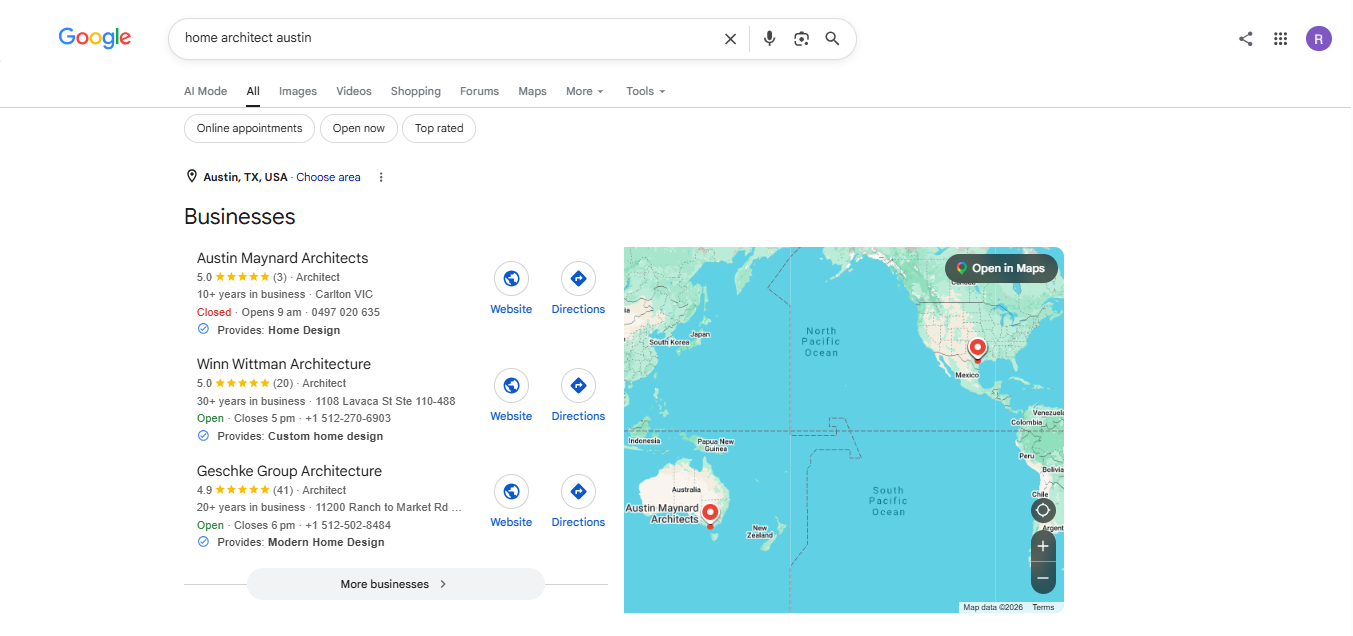
- Claim and complete your Google Business Profile. Category, service areas, hours, and real project photos. This is the single biggest local ranking factor.
- Keep your name, address, and phone identical everywhere. On the site, on Houzz, in local directories and your chamber of commerce. Google reads consistency as a trust signal.
- List on Houzz. It remains the platform homeowners use most to find and vet architects, and it reinforces the same entity signals Google already reads.
- Earn Google reviews. Ask every finished client. Reviews feed both the map pack and the trust a prospect feels before calling.
Visual and portfolio SEO
Architecture sells on images, and search reads them poorly unless you help. Your portfolio is your best SEO asset once it is built for discovery, not just for looks.
- Give every project its own page. One page per project, named for what it is: “modern lakeside home, [city].” Each becomes an entry point for a specific search.
- Write real alt text. Describe the image and the project (“rear extension with steel-framed glazing, [city]”), not “IMG_4021.” This feeds image search and accessibility.
- Compress and size images. Large photos slow the page, and speed affects both ranking and the impression a prospect forms in the first second.
- Add project schema. Structured data helps search and AI understand the work. More on that in how rich snippets help SEO.
Proof, trust, and AI answers
Google and AI engines both reward evidence that you have done the work. For an architecture firm that means case studies with outcomes, named architects with credentials and registration, and client reviews. This is E-E-A-T, and for a considered purchase like design services it decides who gets the call.
The newer surface is AI answers. When a prospect asks ChatGPT or Google’s AI for “a sustainable architect in [city],” you want to be named. The mechanics overlap with everything above plus clear, quotable content, which is the whole subject of answer engine optimization, and the reason GEO is mostly SEO applied to a new place. Traffic only matters if it turns into inquiries, so pair all of this with the conversion work in conversion rate optimization.
A 90-day roadmap
Three months, in order. Each phase ends in something a prospect can find.
FAQ
How long does SEO take to work for an architecture firm?
Local results move fastest. A well-optimized Google Business Profile with consistent citations and a few reviews can start showing in the map pack within four to eight weeks. Competitive service-plus-location terms take three to six months of steady content and links. Referrals fill the gap while it compounds.
What keywords should an architect target?
Service or project type paired with a place: “residential architect in [city],” “Passivhaus architect,” “listed building renovation architect,” “commercial building design [city].” Skip the broad term “architect” on its own; it rarely converts. Give each real service-and-city combination its own page.
Is local SEO or Houzz better for getting clients?
Both, and they reinforce each other. Local SEO through your Google Business Profile usually drives the most qualified inquiries, while Houzz is where many homeowners browse and vet firms. Keeping your name, address, and phone identical across the site, Google, and Houzz strengthens all of them at once.
Do I need a blog to rank as an architect?
Not a blog for its own sake. What ranks is pages that match real searches: service pages, city pages, and a page per project. Answer the questions clients actually ask, like cost ranges, timelines, and the planning process, and those pages do more than a generic blog ever would.
How do I get my firm cited by AI search?
The same work that ranks you also gets you cited: a strong local presence, clear service and location pages, real project evidence, and content that answers questions directly in a way an AI can quote. Structured data and consistent entity signals across the web help engines recognize and repeat your firm’s name.